
Centipedes vs. Millipedes: What's the Difference?
Are Centipedes and Millipedes Dangerous in Phoenix Homes?
A house centipede can deliver a bite that stings sharply for a few minutes, similar to a bee sting, but it isn't dangerous to a healthy adult or pet. Millipedes can't bite at all. Instead, they release a defensive fluid when threatened that can irritate skin and stain fabric on contact. Getting the two pests identified correctly matters because the right response to each one is different.
How to Tell a Centipede from a Millipede
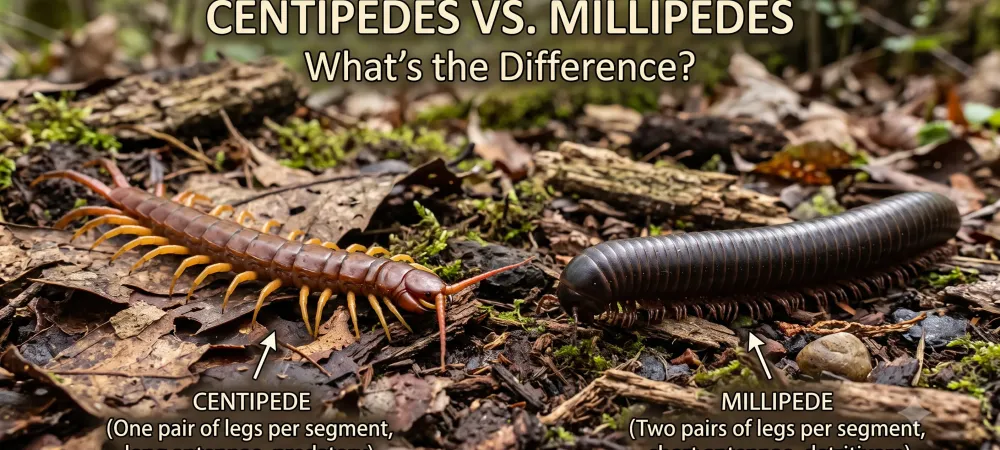
The fastest way to tell them apart is speed and leg count. Centipedes have one pair of legs per body segment and move fast enough to disappear the moment a light comes on. Millipedes have two pairs of legs per segment, move slowly, and typically curl into a tight spiral rather than run.
| Feature | Centipede | Millipede |
|---|---|---|
| Legs per segment | One pair | Two pairs |
| Movement | Fast, skitters away | Slow, curls when threatened |
| Body shape | Flattened, long legs | Rounded, many short legs |
| Diet | Predator — eats other bugs | Scavenger — eats decaying plant matter |
| Can it bite? | Yes, mildly painful | No — releases irritating fluid instead |
Centipedes hunt other insects for food, so finding one indoors usually means there's a food source nearby worth investigating. Millipedes feed on decaying leaves and mulch, which points to a moisture or landscaping issue right outside the door where it was found.
Where They Turn Up Inside the House
Centipedes most often show up in bathrooms, sinks, and tubs, since these stay the dampest with the least foot traffic. Millipedes tend to appear in garages, laundry rooms, and near exterior door thresholds, wandering in from mulch beds just outside and getting stranded on dry indoor flooring. Neither pest can establish a colony indoors because Phoenix homes are simply too dry for them. Finding one inside almost always means it wandered in from an established population right outside.
Why Phoenix Sees More of Both After Monsoon Season
Centipede and millipede sightings around Phoenix homes climb sharply between July and September, tracking directly with monsoon humidity. Both pests depend on moisture to survive in a desert climate, and a sudden run of rain after a dry summer pushes them out of drying soil and toward cooler, damper spots, including a home's foundation line. This pattern follows the weather every year, not a sign that something changed inside the house.
What Draws Them to Your Property
- Mulch or wood beds pushed up against the foundation
- Leaf litter or decaying vegetation left to build up
- Over-irrigated or overwatered landscaping near the house
- Gaps under exterior doors and unscreened weep holes
- Exterior lighting that attracts the small insects centipedes hunt
Does Store-Bought Spray Actually Solve the Problem?
A common assumption is that spraying the exterior perimeter with a retail bug spray clears out centipedes and millipedes for good. Surface sprays do kill what's on contact, but they don't touch the moisture and harborage conditions actually drawing the pests toward the house. Within a week or two, new centipedes or millipedes show up in the same spots the spray was applied. Correcting the moisture source and sealing entry points solves the underlying problem, while repeated spraying only treats what's already visible.
When to Call a Professional
Seeing a single centipede or millipede outdoors near the foundation is normal desert activity and rarely needs treatment. Regular indoor sightings, especially after monsoon season, point to an entry point or moisture issue worth a professional look. Our pest library covers more of the bugs common to Phoenix yards, and general pest control service from Greenleaf Pest Control addresses the harborage conditions driving activity, not just the pests currently visible. For a broader look at what else turns up in Valley homes, see our guide to the most common bugs in Phoenix.
Common Questions About Centipedes and Millipedes in Phoenix
Do house centipedes eat other bugs in my home?
Yes. Centipedes are predators that hunt spiders, roaches, and other small insects, so their presence usually means another pest is already established nearby.
Can millipedes hurt my pets?
Millipedes aren't venomous, but the defensive fluid they release can irritate a pet's mouth or eyes if bitten or pawed at, so it's worth rinsing the area and watching for irritation.
Why am I suddenly seeing centipedes at night?
Centipedes are nocturnal hunters that stay hidden during the day and become active after dark, so nighttime sightings are normal behavior on their own rather than a sign of a growing problem.
Does a lot of centipede activity mean a bigger pest problem?
Heavy centipede activity can point to a bigger problem. Because centipedes feed on other insects, unusually high numbers often mean there's a larger prey population, such as roaches or ants, supporting them nearby.
Not Sure What You're Dealing With?
Dealing with centipedes or millipedes at your place, or just not sure what you're looking at?
Call Greenleaf Pest Control at 623-399-9970