
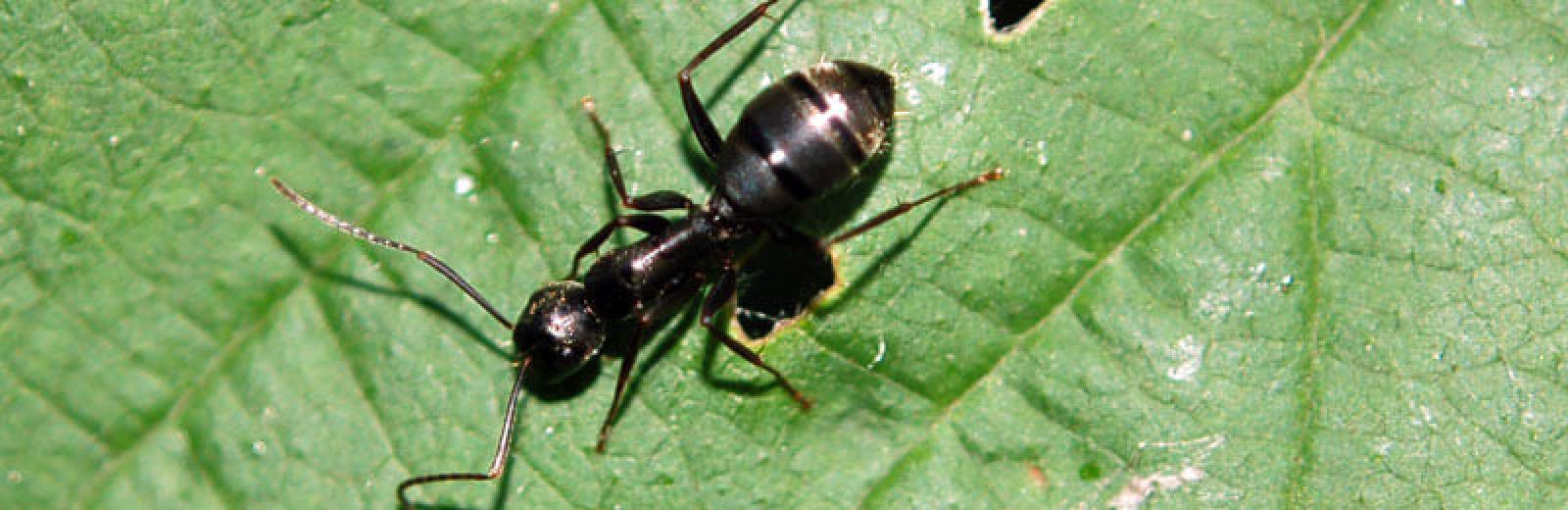
Quick Identification
Light to dark brown ants, about 1/12" to 1/8" long, moving in dense, fast-moving trails rather than single-file lines, typically near irrigation, pools, or consistently damp landscaping.
What Do Argentine Ants Look Like?
Argentine ants are small, uniformly light to dark brown ants, typically about 1/12 inch to 1/8 inch long. Individually, they look fairly unremarkable compared to other small household ants in the region. The giveaway is almost always the sheer number of ants moving together. Argentine ant trails are dense and fast-moving, often several ants wide, rather than the thinner single-file lines typical of species like odorous house ants.
Colonies build shallow nests in moist soil, mulch beds, under potted plants, or beneath stones and pavers, almost always somewhere with reliable access to water. In the Phoenix area, this makes irrigated landscaping, pool decks, and drip-line areas prime real estate for this species.
| Size | 1/12" – 1/8" |
| Color | Light to dark brown |
| Identifying trait | Dense, fast-moving multi-ant trails |
| Sting | No |
| Typical location | Irrigated landscaping, pool decks, mulch beds, potted plants |
Argentine Ant Behavior & Habits
Argentine ants form some of the largest colonies of any ant species found around Phoenix homes, frequently containing multiple queens and expanding rapidly through budding, where a portion of the colony splits off to establish a new nest nearby. Because they depend heavily on consistent moisture, colonies are especially persistent around homes with pools, irrigation systems, and well-watered landscaping. These are exactly the features that make many Phoenix-area yards attractive to this species in the first place.
These ants are also notably aggressive toward other ant species, often displacing native ants from an area entirely, which is part of why an established Argentine ant colony can seem to appear and take over a yard quickly.
Myth: Removing a Nest You Find Solves the Problem
Removing a single Argentine ant nest rarely solves the underlying problem. Colonies expand through budding, where portions split off to form new nests nearby, so disturbing one nesting site, like a stack of pavers, often relocates activity a few feet away rather than eliminating it. The interconnected network of nests needs to be addressed as a whole.
DIY Approaches and Their Limits
- Because colonies are so large and interconnected, killing visible trail ants barely dents the overall population.
- Removing one nesting spot, like a stack of pavers or a potted plant, usually just relocates activity a few feet away rather than resolving it.
- Store-bought sprays can disrupt a small section of trail temporarily but won't reach the full network of interconnected nests typical of this species.
Prevention Around Phoenix-Area Homes
- Reduce standing moisture near the foundation by checking irrigation timing and drip-line placement.
- Avoid overwatering potted plants and garden beds, which create ideal shallow nesting conditions.
- Keep mulch and stone landscaping features a few inches from direct wall contact.
- Seal cracks and gaps at ground level where trails commonly enter structures.
Argentine Ants in Phoenix, Mesa & Scottsdale Yards
Why do I have so many ants around my pool in Phoenix?
Argentine ants are drawn to consistent moisture, and pool decks, along with the landscaping and irrigation typically surrounding them, provide exactly that in an otherwise dry climate. Dense, fast-moving trails near a pool are a common sign of this species specifically.
Why did my ant problem in Mesa get worse after I removed a nest?
Argentine ant colonies expand through budding, where portions of a colony split off to form new nests nearby. Disturbing one nesting site, like a stack of pavers, often relocates activity rather than eliminating it, which can look like the problem worsened.
Are Argentine ants harmful to my Scottsdale landscaping?
They don't damage plants directly, but large colonies can outcompete and displace beneficial native ant species in the yard, and their sheer numbers make them one of the more persistent nuisance ants to deal with without professional treatment.
Seeing Dense Ant Trails Near Your Pool or Landscaping?
Dealing with Argentine ants at your place, or just not sure what you're looking at? Call Greenleaf Pest Control at 623-399-9970 and we'll help you figure out the right next step.
Get a Free QuoteArgentine ant treatment is included in our ongoing pest control service, covering Phoenix, Mesa, and Scottsdale yards.